



What Florals Really Mean: The Deeper Language Behind Summer's Favourite Motif
The Floral Motif Has a Meaning in Fashion That Goes Far Deeper Than Pretty
A floral motif in fashion is not simply a decorative choice. It is a form of language. For thousands of years, across cultures that never shared a border, humans reached for flowers when they wanted to say something that words made difficult. They printed them on silk, wove them into cotton, and embroidered them onto ceremony and everyday life alike. The flower was never just ornament. It was always communication.
Every summer, the floral print returns to bags, scarves, kurtas, and accessories across India and around the world. Most people wear it because it is beautiful and feels right for the season. But there is a more interesting reason it keeps coming back, and understanding that reason changes the way you see the pieces you already own.
This is what florals are really saying.
"The flower was the original cryptic language. Long before typography, humans wore their meaning on their clothes."
How the Floral Print Travelled from Ancient India to Your Wardrobe
The floral motif in fashion has ancient roots, and many of those roots begin in India. Floral patterns appeared on Indian temple sculptures, court textiles, and everyday cotton long before they reached European trade routes. The lotus, the marigold, the rose, and the jasmine each carried distinct symbolic weight in Indian culture, representing everything from divine purity to auspicious celebration to love. When these textiles reached Europe through trade, the patterns travelled with them and were absorbed into entirely different symbolic systems.
Flowers as Divine Language
Floral motifs in Indian textiles carried deep sacred meaning. The lotus represented purity and spiritual enlightenment in both Hindu and Buddhist traditions, rising from mud to bloom above it. The marigold signified celebration and auspiciousness. These motifs were woven into Banarasi silks, embroidered onto Phulkari from Punjab, hand-painted onto Kalamkari from Andhra Pradesh, and stitched into Kantha from Bengal. The flower was not decoration. It was prayer made visible.
Floriography: The Secret Language of Flowers
Victorian England formalised what many cultures had practised informally. The practice became known as floriography, and it was precisely what the name suggests: a coded language communicated through flowers. Every bloom had a specific meaning. Red roses meant romantic love. Violets communicated modesty. Daisies said innocence. A woman could express emotions that polite society would not allow her to speak aloud, simply through which flowers appeared on her dress or in her arrangement. Florals in fashion became a form of coded self-expression.
Flower Power: Florals as Political Statement
In the 1960s, the floral pattern became something else entirely. The counterculture movement adopted flowers as a symbol of resistance, peace, and non-violence during the Vietnam War era. Wearing flowers was a direct political statement about what kind of world a person wanted to live in. The flower chose softness over aggression. It was, in that context, a radical act. The phrase "flower power" was not metaphor. It was a genuine assertion that beauty had political weight.
The Return of Intentional Florals
Starting on the Spring 2025 runways, designers including Loewe, Chloe, and Simone Rocha presented florals not as nostalgic decoration but as a considered vocabulary. Runway critics noted the return of florals to "the fashion insider's wardrobe" after years where the pattern had felt expected and overly safe. That interpretation has carried through into the seasons since. Florals chosen deliberately, printed with intention, worn as a statement rather than a default, carry a meaning that lazy floral application simply does not.
What Specific Floral Prints Mean When You Choose to Wear Them
The meaning of a floral pattern in fashion changes depending on the flower, the scale, the colour, and the context. A large-scale rose in deep red says something entirely different from a scattered meadow print in forest green. Understanding these differences helps you choose florals that align with what you actually want to communicate, rather than wearing a print because it happened to be available.
The Rose
Love, beauty, passion, and feminine authorityThe rose is the most widely recognised floral symbol in the world, and its meaning shifts with colour. Red roses carry romantic love and passion. Pink roses communicate admiration and grace. White roses speak to purity and new beginnings. In fashion, rose motifs have historically been associated with both feminine beauty and feminine power. Christian Dior built an entire aesthetic identity around the rose, and contemporary designers like Maria Grazia Chiuri have used it to explore what reclaimed femininity looks like. Wearing a rose print is a statement about beauty as something owned rather than performed.
The Lotus
Purity, spiritual strength, and rising above difficultyThe lotus is one of the most symbolically significant flowers in Indian culture and across Buddhist and Hindu traditions. It grows in muddy water and blooms above the surface, which is why it became a symbol of purity achieved through difficulty, of beauty that does not depend on perfect conditions. In Indian textile tradition, the lotus motif appears in everything from Mughal court fabrics to contemporary block-printed cotton. Wearing a lotus-inspired print carries this meaning with it: that beauty and grace are not things you are handed, but things you grow towards.
The Meadow Print
Freedom, growth, and connection to natureA meadow print, by its nature, is a collection of wildflowers rather than a single named bloom. This matters symbolically. A cultivated garden communicates order and control. A meadow communicates abundance without arrangement, beauty without rigid structure. Meadow florals in fashion have historically been associated with the pastoral, with freshness, with life that has not been made to conform to any particular shape. In contemporary fashion, the meadow print reads as an expression of ease, openness, and genuine connection to the natural world rather than the managed version of it.
The Scattered Dot-and-Bloom
Playfulness, lightness, and deliberate joyA scattered floral pattern, where blooms are distributed loosely across a ground rather than arranged in formal repetition, reads entirely differently from a structured botanical print. The scatter is inherently playful. It suggests movement, spontaneity, and a lightness of being that more formal arrangements do not. In Indian fashion, scattered prints on satin and chiffon have long been a popular choice for occasions that call for joy without ceremony. The pattern communicates that you are someone who chooses beauty because it pleases you, not because it conforms to expectation.
Why Wearing a Floral Print Changes the Way Both You and Others Experience Your Presence
Research into colour psychology and pattern recognition consistently finds that exposure to natural motifs, including floral patterns, has a measurable positive effect on mood. Wearing a floral print is not simply an aesthetic decision. It is also an emotional one.
Vibrant, multi-coloured floral prints tend to project energy, approachability, and optimism. People who wear them are generally perceived as more open and warmer than people in solid, neutral tones. Softer, tonal florals in muted or pastel shades project calm, sophistication, and quiet confidence. Bold, oversized florals communicate strength and a deliberate sense of style. None of these is better than the others. They are simply different messages.
There is also a seasonal psychological dimension. In an increasingly urbanised world, floral prints offer a visual and psychological connection to nature. Flowers are associated with growth, renewal, and the particular quality of light that comes with summer. Wearing them during summer is partly about seasonal alignment: choosing a pattern that mirrors what the natural world is doing at the same time you are wearing it.
In Indian culture, this runs even deeper. Flowers are inseparable from ceremony, from the divine, from the moments that matter most in a life. Wearing floral prints carries some of that associative weight, whether consciously or not. A printed scarf with a meadow or lotus motif is not just a style choice. It is a small act of connection to a very long cultural conversation.
Three Floral Families, Three Distinct Meanings
House of Kiyaara's scarves and stoles collection is built around three floral design families, each with its own print identity, colour story, and symbolic meaning. Understanding what each one says allows you to choose the piece that aligns with what you want to carry into your day.
Midnight blue is the colour of the sky at the moment between dusk and darkness, and the Muse print reflects that particular quality of light. It communicates creative depth and a sense of self that does not need loudness to be felt. The woman who reaches for the Muse Stole Midnight Blue is not trying to be noticed. She simply is.
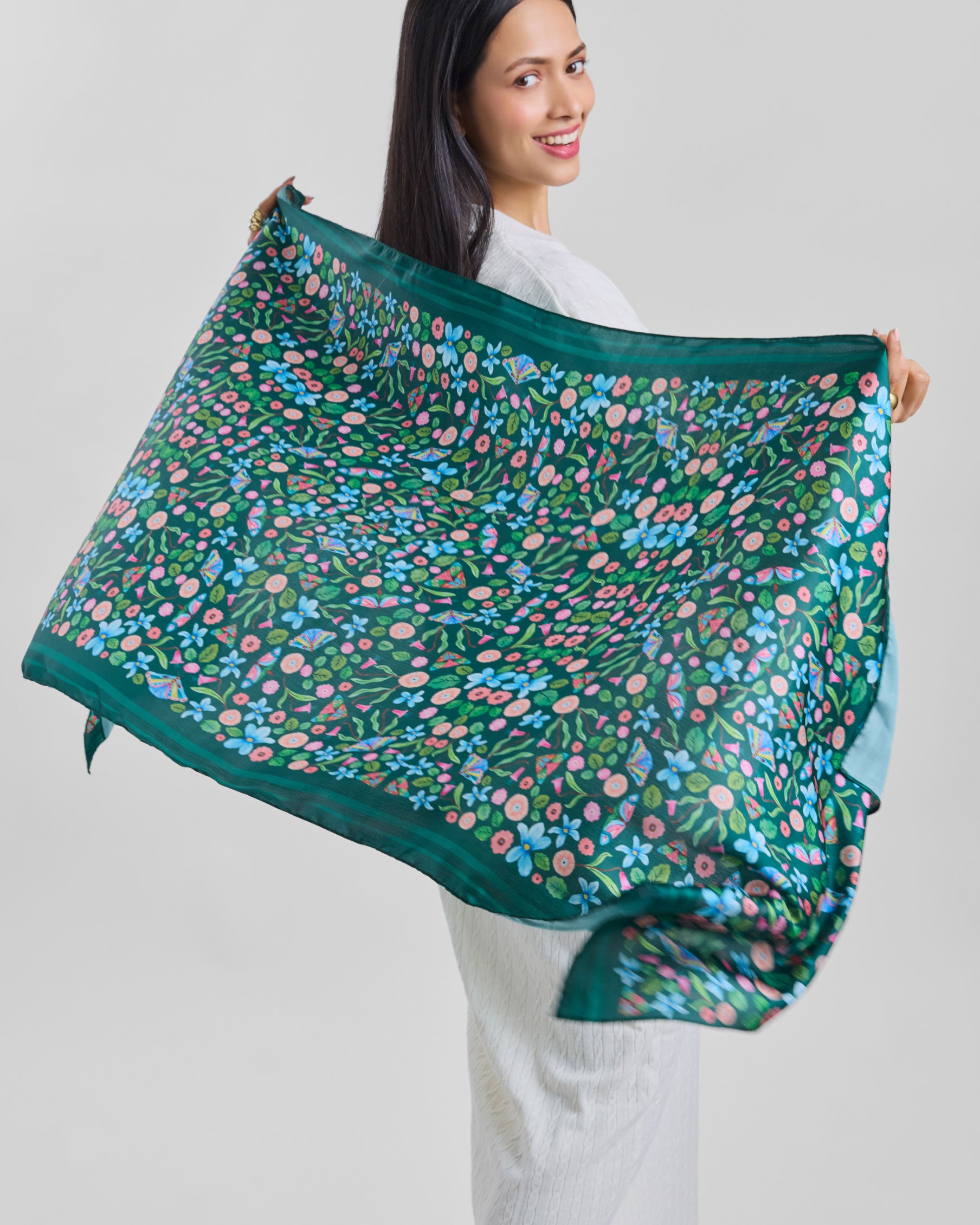
Shop Muse StoleForest green is the colour of living things at their most vital, and the Meadow print brings the looseness and abundance of a wildflower field to everything it touches. It is the most grounded of the three families. Wearing it communicates a deep ease with the natural world and a sense of personal growth that is ongoing rather than performed.
Shop Meadow StoleSky blue is the most open of all colours and the Dottie print, with its scattered, playful arrangement, reflects that openness completely. It is the print you reach for when you want to feel light, when you want an outfit to breathe, when the occasion calls for joy without formality. It communicates that you have chosen happiness with intention.
Shop Dottie StoleThe Meadow Stole Forest Green: When a Print Carries a Point of View
A wildflower print that says everything about growth and ease without saying a word
The best florals are never accidental. They are chosen. And the Meadow Stole Forest Green is the kind of piece that rewards being chosen deliberately, because it carries real symbolic weight in its print.
The meadow print represents nature at its least managed: abundant, loose, genuinely alive. Forest green in Indian cultural tradition is associated with growth, fertility, and prosperity. Together, they produce a scarf that communicates groundedness and ease in equal measure. It is from our scarves and stoles collection at Rs. 1,650, printed on lightweight satin that drapes beautifully across the shoulders or at the waist. Generously proportioned to work across every styling method.
Wear it knowing what it means. That changes the wearing of it entirely.
The Muse Large Square Scarf Midnight Blue: The Print for Someone Who Has Thought About It
Midnight blue floral artistry for the woman who does not choose things without reason
The Muse print in midnight blue is not a background pattern. It has presence. It communicates the kind of considered aesthetic that comes from someone who knows what they like and has stopped apologising for it.
Midnight blue in the Indian colour tradition carries associations with depth, the divine, and the creative spirit. The Muse Large Square Scarf at Rs. 850 is a medium-weight square format that works as a headband, a bag accent, or the open chest tuck described in our scarf styling guide. The print does not demand attention. It earns it.
This is the scarf for the woman who has thought about what she puts on her body and why.

Every Floral Tells a Story. Choose the One That Tells Yours.
Browse the full Kiyaara scarves and stoles collection and find the print that aligns with what you want to carry into this season.
Shop All Scarves Shop Bestsellers